Baggies and Meet Baggies: A Deep Dive into the Bold Script Display Typeface
When designers search for a typeface that bridges the gap between casual approachability and high-impact visual presence, they often find themselves navigating a crowded market of generic scripts or rigid sans-serifs. Baggies stands out in this landscape not merely as another font file, but as a distinct character study in boldness and nostalgia. Created by hand to capture the essence of 1970s and 80s branding, this typeface offers a unique combination of smooth flow and thick, robust letterforms that feel both tasty and timeless.
The core identity of Baggies lies in its ability to convey personality without sacrificing legibility. Unlike traditional script fonts that rely on thin, delicate strokes which can disappear at small sizes, Baggies utilizes a heavy weight that demands attention. This makes it an excellent candidate for projects where immediate recognition is required, such as product labels, event posters, or social media graphics. The font's design philosophy centers on the "handmade touch," yet it delivers the consistency needed for professional commercial applications.
Understanding the Distinctive Features of Baggies
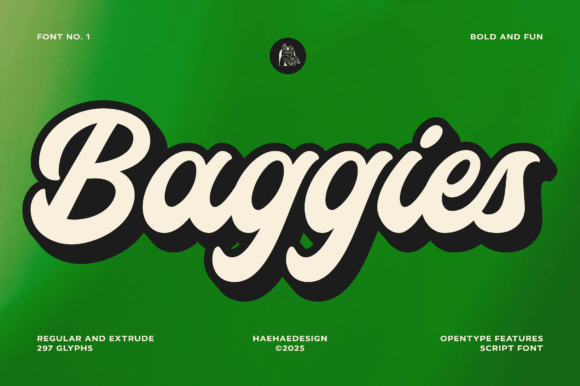
To evaluate whether this typeface fits your project, one must first understand its structural DNA. The defining characteristic of Baggies is its extrusion capability. While many display fonts offer standard outlines, the Extrude version included in the Baggies family creates an immediate three-dimensional effect. This feature allows headlines to achieve a deep, layered look that mimics physical objects, adding depth and memorability to text-based designs without requiring complex graphic manipulation software.
Beyond the 3D capabilities, the base letters possess a dynamic, playful rhythm. The curves are confident and fluid, avoiding the jittery or overly ornate nature found in some retro revival fonts. Instead, the flow feels organic, as if written with a broad marker or a thick paintbrush. With a comprehensive library of 297 glyphs and full OpenType support, the font provides the necessary tools for nuanced typography, including ligatures, alternate characters, and stylistic sets that allow designers to tweak the personality of the text while maintaining the overall aesthetic.
This versatility is crucial when adapting the font to different contexts. The same family can be used for a logo that needs to appear sturdy and reliable, or for a menu item description that requires a sense of fun and indulgence. The balance between the "bold" and the "script" elements ensures that the text remains readable even when stylized heavily.
Comparing Baggies to Other Display and Script Options
In the realm of vintage-inspired typography, designers often face a choice between strict historical accuracy and modern adaptability. Many retro fonts from the 70s and 80s era suffer from being too literal, replicating the imperfect scan lines and low-resolution artifacts of the original print era. Meet Baggies, however, takes a different approach. It captures the spirit of that decade—the colors, the shapes, and the energy—while refining the geometry for contemporary screens and high-resolution printing.
When compared to standard cursive scripts, Baggies offers significantly more weight. Standard scripts often struggle to compete against background images or busy layouts because their thin strokes lack visual dominance. In contrast, the thick letters of Baggies act as a solid block of color, making them ideal for headers and short phrases where impact is paramount. However, this comes with a tradeoff: the heavy weight means the font is less suitable for body copy or long paragraphs of text. It is strictly a display typeface, intended for headlines, logotypes, and short captions.
Another point of comparison involves the "handmade" aspect. Some fonts simulate handwriting by introducing random irregularities in stroke width and alignment. While these can add charm, they often require extensive manual kerning and adjustment to look professional. Baggies maintains a consistent baseline and stroke weight, ensuring that the text looks cohesive and polished. The "handmade" quality here is achieved through the curvature and spacing of the forms rather than chaotic imperfections, offering a cleaner result that still feels personal and crafted.
Evaluating Strengths, Tradeoffs, and Best-Fit Scenarios
Selecting the right typeface is always a matter of matching the tool to the task. For projects requiring a throwback aesthetic, Baggies excels in specific categories where its strengths shine brightest. Its primary advantage is the ability to evoke nostalgia instantly. Whether you are designing packaging for a snack brand, creating merchandise for a music festival, or crafting a logo for a coffee shop, the 1970s and 80s vibe communicates warmth and approachability.
- Packaging Design: The bold weight and Extrude features make Baggies perfect for front-of-pack labeling. The 3D effect adds a tactile quality that suggests richness and flavor, aligning well with food and beverage products.
- Social Media and Digital Ads: On mobile devices, space is limited, and attention spans are short. The thick, clear letterforms of Baggies ensure that messages are read quickly and remembered effectively, cutting through the noise of flat, minimalist designs.
- Apparel and Stickers: The playful curves translate exceptionally well to screen printing and vinyl cutting. The rounded edges prevent sharp corners that might snag during production, while the bold style ensures visibility from a distance.
However, there are limitations to consider. Because Baggies is a display font with a specific thematic voice, it is not a universal solution. If a project requires a neutral, understated tone, or if the design language is strictly corporate and modernist, Baggies may feel too loud or dated. Additionally, while the Extrude version is powerful, it relies on the viewer's ability to process depth; in very small sizes, the 3D effect can become muddy and lose definition. In such cases, using the standard 2D outline of the font is the safer, more legible choice.
Making the Decision: When to Choose Baggies
Deciding to incorporate Baggies into a design workflow should depend on the emotional goal of the project. If the objective is to create a connection based on comfort, fun, or retro cool, this typeface is a strong contender. It works particularly well when paired with vibrant color palettes, as the thick strokes provide a solid foundation for contrasting hues.
Conversely, if the project demands elegance, minimalism, or a futuristic edge, other options may serve better. Fonts with thinner weights or geometric precision might be more appropriate for luxury brands or tech startups. Furthermore, while Baggies offers 297 glyphs, users requiring highly specialized punctuation or multilingual support should verify the specific character set coverage for their target audience, as display fonts sometimes prioritize stylistic variety over comprehensive language support.
Ultimately, the choice between Baggies and similar alternatives comes down to the narrative you wish to tell. Do you want your design to feel like a handwritten note passed around a group of friends? Or do you need a structured, architectural typeface? Baggies occupies a unique middle ground: it is bold enough to stand alone, yet fluid enough to feel inviting. By leveraging its two distinct styles and the powerful Extrude feature, designers can create work that feels both historically grounded and freshly energetic.
For those looking to inject a splash of vintage personality into logos, flyers, menus, or clothing, Baggies offers a reliable and visually delicious solution. It transforms simple text into a statement, proving that a font can be both a functional tool and a creative asset. As with any design decision, testing the typeface within the actual layout context is the best way to determine its efficacy, but its inherent qualities suggest it will perform well in any scenario demanding confidence and charm.